Build vs. Buy Software in the Age of AI: Why the Old Rules No Longer Apply
A product manager at a mid-size company spent three months evaluating project tracking tools. She demoed fourteen vendors, sat through dozens of sales calls, filled out security questionnaires, negotiated pricing. None of the tools quite matched her team's workflow. Then a colleague described what they needed to an AI app builder and had a working prototype by lunch. Not perfect -- but functional, and built around the way her team’s workflow actually works using AI.
That story captures why the old build vs buy software pros and cons framework for software decisions is falling apart. The traditional calculation assumed that building was expensive and slow, while buying was cheap and fast. Neither assumption holds the way it used to.
The Traditional Build vs Buy Software Framework
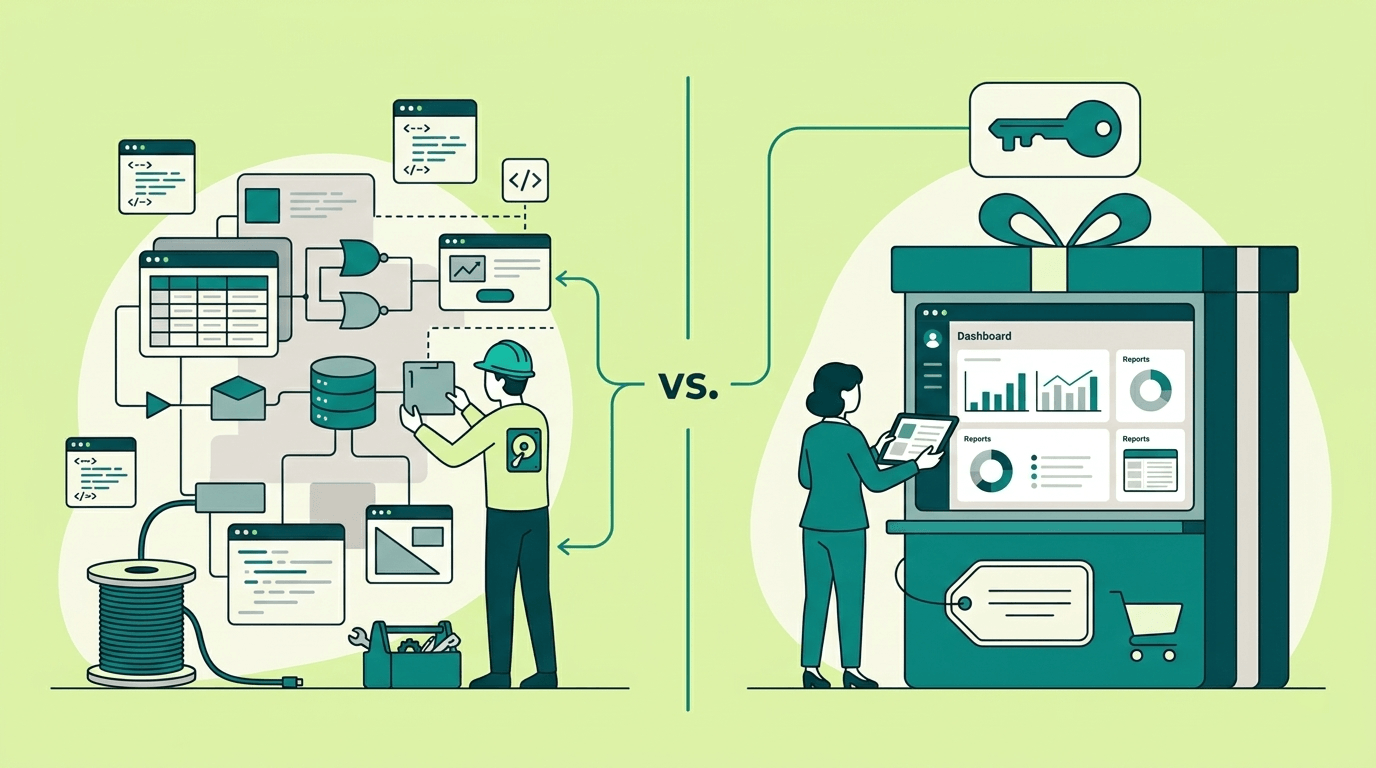
For years, the decision to buy or build a custom software solution followed a simple pattern. Building meant hiring a company to build an app (or assembling an internal team), spending months on requirements and development, and investing serious money before seeing results.
Buying meant choosing third-party software -- typically buying off-the-shelf software from a vendor. It was fast to deploy with predictable subscription costs. But you had to reshape your processes to match what the vendor offered, often limiting customization for your specific business needs.
The conventional wisdom was straightforward. If the problem is common -- accounting, email, basic CRM -- buy it. When to build software? Only when the requirement is genuinely unique, and the capability gives you a competitive edge. This made sense when hiring someone to build an app meant a six-figure commitment and a timeline measured in quarters.
What it missed is that "unique" is more common than people assume. Almost every business has workflows, approval chains, or data relationships that don't map cleanly onto generic tools. The 80% fit from off-the-shelf software was considered good enough because closing that last 20% gap was prohibitively expensive. That gap is where most of the frustration lives -- and it's exactly where things have changed.
How AI Changed the Build vs Buy Software Decision
AI collapsed the cost of software development in a way that would have seemed absurd five years ago. The ability to build applications fast -- from natural language descriptions, without writing code -- moved from science fiction to production tooling.
You no longer need to hire a programmer to make an app every time your operations team needs a better approval workflow or your sales team wants a custom dashboard. The cost to build a SaaS platform or internal tool has dropped by an order of magnitude for many use cases.
Building a minimum viable product used to require weeks of developer time and tens of thousands in budget. Founders and product managers can now build a minimum viable product in a weekend -- not a polished product, but something real enough to test with users and learn from. The bottleneck has shifted. The scarce resource isn't engineering capacity anymore. It's knowing clearly what you need and being able to describe it well.
This doesn't mean engineering is irrelevant. Complex, mission-critical systems still need skilled developers. But a huge category of business tools -- the ones that used to live in spreadsheets or not exist at all because IT had bigger priorities -- can now be built by the people who understand the problem best.
Buy vs Build Custom Software Is No Longer a Binary Decision
The old build-or-buy binary has stretched into a spectrum with room in the middle. Think of it as three zones:
Buy Decision still makes sense for commodity problems. You don't need a custom email client or accounting system. Proven SaaS covers these well.
Build from scratch still makes sense at the other extreme -- proprietary algorithms, deep integrations with unique data, systems where every design choice matters. If you're going to build a SaaS from scratch with a full engineering team, you'd better be sure the result is a genuine competitive advantage.
The interesting shift is in between. A growing category of tools lets you create a web application without coding, build a web app with no code, or use AI to make an app from a description of what you need. Some people create apps with ChatGPT as a starting point. Others use dedicated AI app builders like Lovable, Bolt, Replit, or Chattee to generate full-stack applications -- database, authentication, business logic, deployment -- from a conversation.
This middle zone is also where entrepreneurs build SaaS with AI or build SaaS with low code to test ideas quickly. Want to build a micro SaaS product around a niche problem? You can validate the concept before writing a single line of code yourself. The barrier to entry for building an app with no coding has dropped low enough that the question isn't whether you can build it -- it's whether you should.
How to Make the Right Software Decisions
So what do you need to create an app the right way in 2026? The factors haven't disappeared, but they've reshuffled.
Time pressure matters more than it used to. If your team needs a tool this week, no vendor evaluation process will keep up. AI builders let you create something functional the same day. If your timeline is more relaxed, a thorough SaaS evaluation might still make sense -- but even then, building a quick prototype first can clarify requirements faster than any requirements document.
Ask how unique your problem really is. Operations managers at SMBs know this pain well: the approval workflow your team runs doesn't match any off-the-shelf tool, but it's not "unique enough" to justify a six-month development project. That gap is exactly where AI-powered building shines. Same goes for agencies delivering client portals, booking systems, or internal tools on tight budgets -- the best way to create a web application for a specific client is increasingly to generate one rather than configure a generic platform.
Think about ownership. Vendor lock-in is real, and it compounds over time. SaaS products change pricing, get acquired, pivot their roadmap. When you build your own web application or SaaS application, you own the result. Platforms like Chattee let you export the complete source code -- frontend, backend, database schemas -- so you're not trading one kind of lock-in for another.
Cost has a different shape now. Traditional custom development: $50k-$500k+. Off-the-shelf SaaS: $500-5,000/month that adds up year after year. AI-built custom tool: a fraction of traditional development cost, and you own what you get.
Who Should Build vs Buy Software (and Why)
Startup founders and product managers -- use AI to make an app prototype before committing engineering resources. The easiest way to build an app for validation is to describe it and iterate. Don't spend months building something nobody wants. Don't buy enterprise software your three-person team will outgrow in six months.
Business teams at SMBs -- you have workflows stuck in spreadsheets because IT has bigger priorities. You can create an app online without coding and solve the problem now. The best software to create a prototype is whatever gets a working version in front of your team fastest. Build SaaS without coding or create SaaS without coding tools to replace manual processes your team runs daily.
Enterprises -- buy for commodity needs, build custom solution for competitive advantage aligned with your business goals. AI tools help you prototype and validate before committing to full custom development. For compliance-sensitive industries navigating buy vs build decisions look for platforms with data residency guarantees and GDPR compliance baked in.
Risks and Cons of Buying or Building Software
AI-generated code needs human review for security-sensitive features. If you're building an AI SaaS product that handles payments, medical records, or personal data, don't skip the security audit.
The "last mile" problem is real. AI gets you a working first version fast, but edge cases, error handling, and integration quirks sometimes still need a developer. The smart approach: AI generates the first version, a developer reviews the critical paths. A project that would have cost $80k becomes a $12k review and refinement exercise.
Lock-in applies to any vendor, including AI builders, especially when ongoing support depends on them. If you can't export your code and run it independently, you've just traded one vendor dependency for another. Choose platforms where you own everything.
How to Make an Informed Build or Buy Software Decision
The old build vs buy decision assumed that a software build was always expensive and risky. That’s no longer automatically true. When you can develop software with AI in an afternoon, the risk calculus flips: choosing the wrong tool from software vendors and spending months fighting its limitations might actually cost more than making the exact custom software your team needs.
The best approach in 2026 is to start small, choose to build something functional, and iterate from there. Begin with the workflow your team has been struggling with, the client tool that keeps getting postponed, or the internal dashboard nobody has time to create.
You might be surprised how far you can go with AI-assisted custom software development before needing a developer at all -- making the decision to build your own software faster and lower-risk than ever.
Chattee is free to start -- no credit card, no commitment. Describe what you need and see what happens.
Curious how AI actually turns a description into a working app? Read our breakdown of How Prompt-to-App Works. Ready to try building something? Follow our 10-Step Checklist: From Idea to Deployed App in One Day.